We are a research group at IMDEA Materials working on computational solid, fluid, and structural mechanics. Our activity spans nonlinear mechanics, computational mechanics, numerical analysis, and applied mathematics. We work on the development of robust numerical methods for the solution of complex problems arising in mechanical, aerospace, civil, and materials engineering.
Recent News

Talk at ICMM9 conference in Prague
Ahsan Kaleem gave a talk entitled A Monolithic Mixed Finite Element Formulation for Thermomechanical Small-strain Elastoplasticity with Temperature-dependent Properties at the 9th International Conference on Material Modeling (ICMM9), held at the Czech Technical University in Prague, September 1-3, 2026. Co-author: I. Romero.
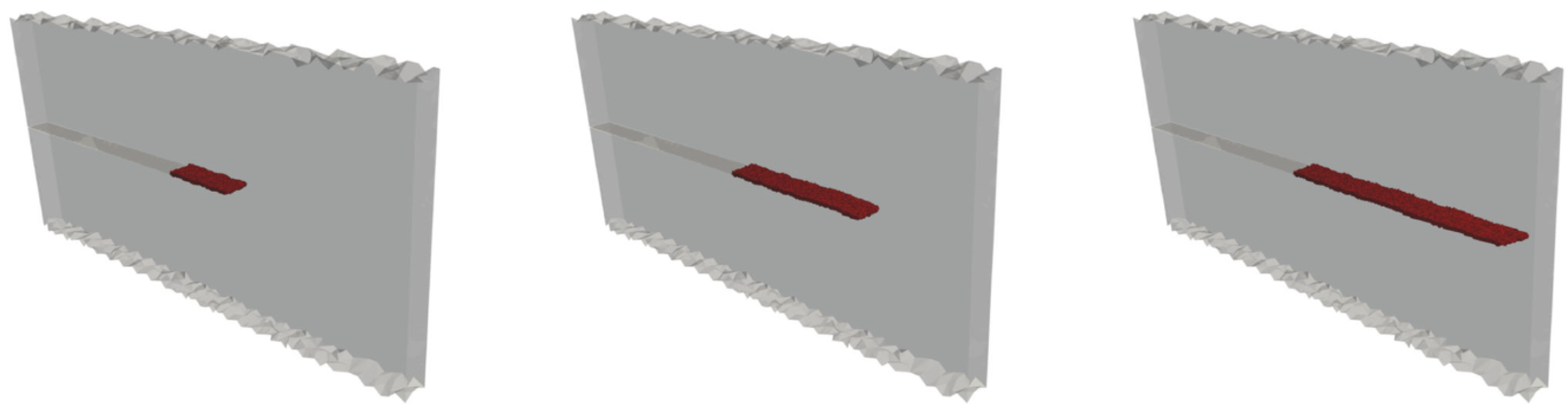
New article: A correction method for crack area overestimation in phase-field fracture
New article: Castillón, M., Segurado, J. and Romero, I. (2026). A correction method for crack area overestimation in phase-field fracture, Computational Mechanics. (link).
Phase-field fracture models systematically overestimate the crack area, a consequence of the diffuse crack representation and of numerical artifacts such as strain localization, where the phase-field variable saturates artificially across finite elements. In this article we propose a correction framework built on the principle of energy equipartition: as the length-scale parameter vanishes, the contributions of the phase field and of its gradient to the fracture energy become equal. Since the numerical artifacts affect mainly the phase-field term while leaving the gradient term largely unperturbed, the crack area can be approximated as twice the gradient-dependent energy. The resulting estimate is mesh-independent, applies to the whole domain, and extends naturally to three dimensions. The method is validated against benchmarks with analytical solutions, compared with skeletonization algorithms, and applied to complex geometries with curvilinear crack paths and to a three-dimensional simulation.
Minisymposium on the lattice Boltzmann method at WCCM-ECCOMAS 2026
Ignacio Romero and Ferdinando Auricchio organized the minisymposium The lattice Boltzmann method as a general-purpose tool in computational mechanics at the 17th World Congress on Computational Mechanics (WCCM-ECCOMAS 2026), held in Munich, Germany, 19-24 July 2026.
Symposium organized at WCCM-ECCOMAS 2026
Christina Schenk and Ignacio Romero organized the symposium MS199 - Learning from Data: Bayesian Methods for Safer and Smarter Computational Modeling in Science and Engineering at the 17th World Congress on Computational Mechanics (WCCM-ECCOMAS 2026), held in Munich, Germany, 19-24 July 2026.
Talk at WCCM-ECCOMAS 2026
Christina Schenk gave a talk entitled Bayesian calibration and uncertainty quantification with advanced surrogates at the 17th World Congress on Computational Mechanics (WCCM-ECCOMAS 2026), held in Munich, Germany, 19-24 July 2026. Co-author: I. Romero.
Talk on mixed finite elements at WCCM-ECCOMAS 2026
Néstor Rossi gave a talk entitled A mixed finite element approach for large-deformation inelasticity with reduced remeshing-induced internal variable diffusion at the 17th World Congress on Computational Mechanics (WCCM-ECCOMAS 2026), held in Munich, Germany, 19-24 July 2026. Co-authors: D. Portillo and I. Romero.
Talk on the Arlequin method at WCCM-ECCOMAS 2026
Ignacio Romero gave a talk entitled Mixed-dimensional coupling with the Arlequin method at the 17th World Congress on Computational Mechanics (WCCM-ECCOMAS 2026), held in Munich, Germany, 19-24 July 2026. Co-author: D. Portillo.
PhD defense of Miguel Castillón
Today, Miguel Castillón successfully defended his PhD thesis entitled Numerical Methods and Algorithms for Phase-Field Fracture Modeling, co-advised by J. Segurado and Ignacio Romero. Congratulations!